The sports editor asked if I would write up the backstory to our fear project so he could share it with the staff. I thought I’d share it here too.
It was 2008, also in Beijing, when Bedel and I worked on a piece that allowed people to experience what it was like to stand atop the Olympic 10-meter diving platform. Bedel had taken our latest toy, a 360-degree camera to the Water Cube, now known as the Ice Cube, current home of curling.
After somehow making his way past three guards and up the ladder to the platform, he got the shots. My much easier contribution was to interview Thomas Finchum, an American diver, on what it’s like to stand up there knowing you’re about to fling yourself off the equivalent of a three-story building.
I asked him what age he was when he got over the fear of being up there. He looked at me and said that he never had, and that he was afraid every time he went up there.
That conversation, and an unformed idea for an Olympic feature, had stuck with me since.
Fast forward to this past September when it was well past time to have an idea for the Winter Games. Having just come back from Tokyo, we met with Archie Tse, the graphics boss. With only months to get something done, he asked if maybe there was a single idea we could dive deeply into.
Funny he should ask.
The Winter Games were always going to be the best setting for this piece. Let’s face it, there’s not a whole lot to be afraid of in the summer version. Even if something goes wrong on the diving platform, you’re still falling into water, not onto a concrete-hard lip of a halfpipe.
We set a couple of ground rules: the fear should be mostly injury based and it should be unique to the Winter sports. For instance, fear of failure or fear of the moment would not qualify, although we would acknowledge those too. (But hey, we’ve all got those fears.)
Then, a bunch of questions:
Could Randy make a writer available to us?
Sure, we’ll settle for John Branch
Where can we find a large group of athletes from different sports and different countries?
Bedel, trying to wrangle time with Eileen Gu, had learned that many of the best winter athletes would be in Saas Fee, Switzerland, in October. He and John Branch started making calls to their freestyle and snowboard contacts. About a dozen interviews were locked in before we got there. Sure, we’ll settle for Shaun White and Eileen Gu.
By the time we left Switzerland, we had interviewed, on camera, twice that many. One thing quickly became clear: they were all scared. We were on to something.
We realized then that we had holes to fill: sliding sports, downhill, ski jumping, short track. A few more trips around the US checked those boxes. We ended with 38 in all. Downhillers, not surprisingly, seemed the most scared. Ski jumpers the least.
How to turn the emotional concept of fear into a visual story?
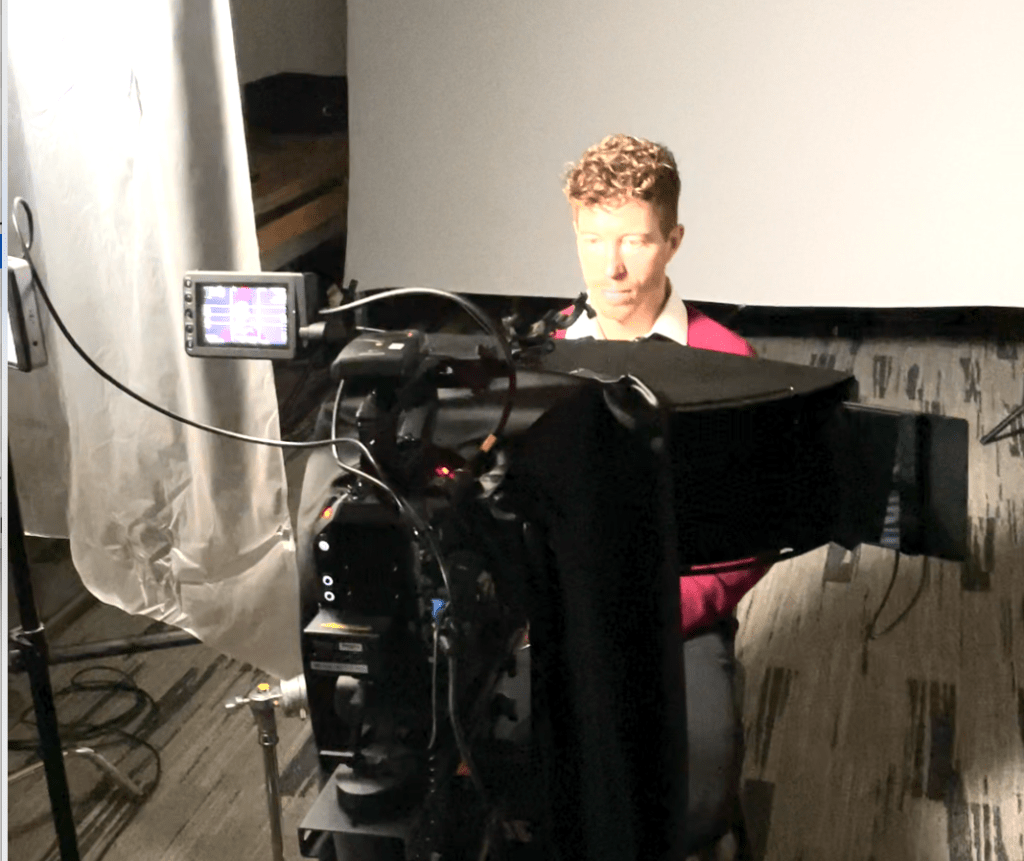
Key to making the emotional connection between athletes and viewers came from Emily Rhyne, our extraordinary cinematographer. In addition to her lighting and background choices, she suggested we use a device called the Eye Direct. It’s a contraption with mirrors that allowed subjects to see John’s face and talk directly to him while actually looking square into the camera’s lens, creating the effect of direct, intimate eye contact with the athletes.
It also became clear that a single piece was not going to do justice to what we were hearing from the athletes. Many ideas were bandied about, including 16 Days of Fear, something for everyday of the Games. Clearer heads prevailed on that idea considering what little time we had.
We ended up with five pieces. Here are the links to them:
Fear of the color of the sky (when the sky and the snow are the same color, it’s hard to know which direction your landing is.)
Fear of skiing blind (a blind Paralympic Alpine skier)


 Eat at Joe’s
Leave a Comment